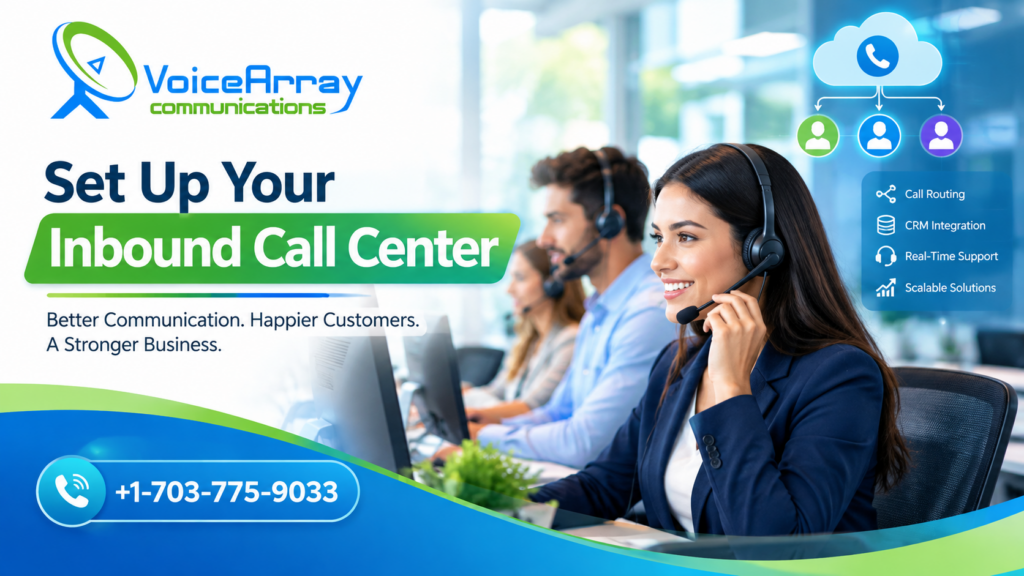
If you want to Set Up Your Inbound Call Center, you need more than phone lines and customer service agents. A successful inbound call center combines trained representatives, reliable communication technology, smart call routing, customer data, quality monitoring, and well-defined processes.
For businesses handling customer questions, technical support, appointments, orders, or service requests, an effective inbound call center can become a central part of the customer experience.
This guide explains how to plan, build, launch, and improve an inbound call center while keeping scalability, customer satisfaction, operational efficiency, and security in mind.
What Is an Inbound Call Center?
An inbound call center is a business communication operation designed primarily to receive incoming customer calls. Instead of focusing mainly on outbound sales calls, inbound teams respond to people who are already contacting a company for assistance, information, support, or service.
Common inbound call center activities include:
- Customer service and account assistance
- Technical support
- Order and payment inquiries
- Appointment scheduling
- Product information
- Complaint and issue resolution
- Help desk services
- Dispatch and service requests
- Lead qualification
- After-hours answering services
Modern inbound call centers may operate through traditional phone systems, cloud-based contact center platforms, VoIP, CRM integrations, interactive voice response systems, and remote-agent technology.
How to Set Up Your Inbound Call Center
To Set Up Your Inbound Call Center effectively, start with business requirements rather than technology. Determine who will call, why they will call, how many calls you expect, when calls will arrive, and what outcomes your agents need to deliver.
A practical setup typically involves the following stages.
1. Define Your Call Center Goals
Begin by identifying exactly what your inbound team needs to accomplish.
For example, a business may want its call center to:
- Improve customer response times
- Reduce missed calls
- Provide technical assistance
- Schedule appointments
- Process orders
- Support existing customers
- Capture qualified leads
- Provide 24/7 answering coverage
Your objectives will influence staffing, technology, training, call routing, and performance measurement.
2. Choose the Right Call Center Technology
Technology is the foundation of a modern inbound operation.
Depending on your business model, your technology stack may include a cloud phone system, VoIP, automatic call distribution, IVR, CRM integration, call recording, reporting dashboards, and workforce management tools.
Automatic Call Distribution (ACD) helps route incoming calls to the appropriate agents based on rules such as department, availability, language, skill, or customer type.
Interactive Voice Response (IVR) allows callers to interact with an automated menu before reaching an agent. A well-designed IVR can direct customers to the right department and reduce unnecessary transfers.
For many businesses, cloud-based contact center technology can also make it easier to add agents and support remote or distributed teams.
3. Design Your Call Routing Structure
Call routing directly affects the customer experience.
Instead of sending every caller to the same queue, create logical routing paths.
For example:
Incoming Call → IVR → Department → Skill-Based Routing → Available Agent → CRM Record
A customer contacting technical support should not have to explain the same technical problem repeatedly to multiple departments.
Your routing strategy should consider:
- Department
- Agent skills
- Customer priority
- Business hours
- Geographic location
- Language requirements
- Agent availability
- Emergency or escalation conditions
The goal is simple: connect customers with the right resource as efficiently as possible.
Build a Customer-Friendly Call Flow
A call center can have excellent technology and still provide a poor experience if its call flow is confusing.
Keep IVR menus short and make the most common options easy to find. Avoid forcing callers through unnecessary menus before allowing them to reach an agent.
Your call flow might look like:
Greeting → Reason for Call → Customer Identification → Routing → Agent Assistance → Resolution → Follow-Up
For complex issues, agents should have a clear escalation process. This prevents customers from being transferred repeatedly without a clear owner for their problem.
Hire and Train the Right Inbound Agents
Technology cannot replace the importance of capable customer service representatives.
Inbound agents should understand your products, services, policies, systems, and escalation procedures. They also need communication skills because customers may call when they are confused, frustrated, or under time pressure.
Training should cover:
- Product and service knowledge
- CRM usage
- Call handling procedures
- Communication skills
- Troubleshooting
- Data privacy
- Security procedures
- Escalation processes
- Difficult customer interactions
Ongoing coaching is equally important. Reviewing recorded calls and performance data can help identify opportunities for improvement.
Integrate Your Inbound Call Center with Your CRM
CRM integration can give agents valuable customer context before they answer.
Instead of asking customers to repeat information they have already provided, agents can potentially access relevant account details, previous interactions, tickets, orders, and notes from connected systems.
This creates a more consistent customer journey.
For example:
Customer Calls → Caller Identification → CRM Record → Previous Interactions → Agent Assistance → Updated Customer Record
The result is a more connected support process.
Monitor Call Center Performance
You cannot effectively improve an inbound call center without measuring its performance.
Important inbound call center KPIs can include:
| KPI | What It Measures |
| Average Speed of Answer | How quickly calls are answered |
| Average Handle Time | Average duration of customer interactions |
| First Call Resolution | Issues resolved during the first interaction |
| Abandonment Rate | Calls disconnected before reaching an agent |
| Service Level | Calls answered within a defined target |
| Customer Satisfaction | Customer perception of the interaction |
| Call Quality | Compliance and quality of agent interactions |
These metrics should not be evaluated in isolation. For example, reducing average handle time may appear positive, but if customers need to call again because their issues were not resolved, the improvement may be misleading.
Make Security and Compliance Part of the Setup
An inbound call center may handle names, addresses, account information, payment details, and other sensitive customer data.
Security should therefore be designed into the operation from the beginning.
Depending on your industry and the type of calls you handle, consider access controls, secure authentication, encryption, employee permissions, call-recording policies, data retention procedures, and appropriate regulatory requirements.
If your inbound operation also performs telemarketing or sales activities, applicable federal and state requirements should be reviewed. The FTC’s Telemarketing Sales Rule addresses areas including disclosures, misrepresentations, calling practices, and certain recordkeeping obligations.
Businesses should obtain appropriate legal or compliance advice for their specific operations rather than assuming that one call-center policy applies to every situation.
Decide Between an In-House and Outsourced Call Center
One of the biggest decisions is whether to build an internal team or work with an outsourced call center provider.
An in-house call center can provide greater direct control over hiring, training, processes, and company culture. However, it may require significant investment in personnel, technology, management, infrastructure, and ongoing training.
An outsourced inbound call center can provide access to trained agents, established communication infrastructure, flexible staffing, and operational expertise without requiring a company to build every component internally.
The right model depends on your call volume, budget, service requirements, operating hours, industry, and growth plans.
Scale Your Inbound Call Center as You Grow
A good inbound call center should be designed for tomorrow, not just today’s call volume.
As your company grows, you may need:
- Additional agents
- Extended operating hours
- Multilingual support
- More sophisticated call routing
- Additional CRM integrations
- Advanced reporting
- Remote-agent support
- Quality assurance programs
- Omnichannel customer support
Cloud-based systems can make scaling easier because businesses can often add users, departments, queues, and capabilities without rebuilding the entire communication infrastructure.
Why Businesses Choose VoiceArray for Inbound Call Center Support
Setting up an inbound call operation requires coordination between communication technology, customer service processes, staffing, and business objectives.
VoiceArray helps businesses explore communication and call center solutions designed around their operational requirements. From business voice services and communication support to customer-facing call workflows, the objective is to create a reliable experience for both customers and internal teams.
For businesses evaluating an inbound call center, the right starting point is understanding the expected call volume, customer journey, required coverage, technology environment, and service goals.
Final Checklist Before Launch
Before you launch your inbound call center, make sure you have:
- Defined your customer service objectives
- Estimated call volume and peak periods
- Selected the appropriate phone or contact center platform
- Designed your IVR and call-routing structure
- Integrated relevant CRM systems
- Created agent training procedures
- Established escalation workflows
- Defined call center KPIs
- Implemented security controls
- Tested call quality and routing
- Created a quality assurance process
- Prepared a scalability plan
A controlled test period before full deployment can reveal routing problems, training gaps, technology issues, and customer-experience weaknesses.
FAQs
1. How do I Set Up Your Inbound Call Center?
To Set Up Your Inbound Call Center, begin by defining call volume, customer needs, operating hours, and service goals. Then select appropriate call center technology, design call routing, train agents, integrate your CRM, establish KPIs, test workflows, and launch with ongoing quality monitoring.
2. What technology is needed for an inbound call center?
A typical inbound call center may use VoIP or cloud telephony, automatic call distribution, IVR, CRM integration, call recording, reporting dashboards, queue management, and agent communication tools. The exact technology depends on call volume, business requirements, security needs, and the level of customer support required.
3. What is the difference between inbound and outbound call centers?
An inbound call center primarily handles calls initiated by customers, such as support requests, appointments, orders, and account questions. An outbound call center primarily makes calls to customers or prospects. Some businesses operate hybrid contact centers that handle both inbound and outbound communication.
4. Can a small business set up an inbound call center?
Yes. Small businesses can start with a cloud-based phone or contact center platform, a limited number of trained agents, structured call routing, CRM integration, and basic performance reporting. Cloud technology can allow the operation to expand as call volume and customer-service requirements increase.
Conclusion
To Set Up Your Inbound Call Center successfully, focus on the complete customer journey rather than simply installing a phone system. The strongest operations combine reliable technology, intelligent call routing, knowledgeable agents, CRM integration, measurable performance, security, and continuous improvement.
Google’s guidance for AI Search also emphasizes useful, original, people-first content rather than creating pages simply to manipulate search results. For businesses publishing call-center resources, that means answering real customer questions clearly and demonstrating genuine expertise.
If your business is planning an inbound call center or looking to improve an existing customer communication operation, VoiceArray can help you evaluate the technology and communication requirements needed for a more organized, scalable customer experience.