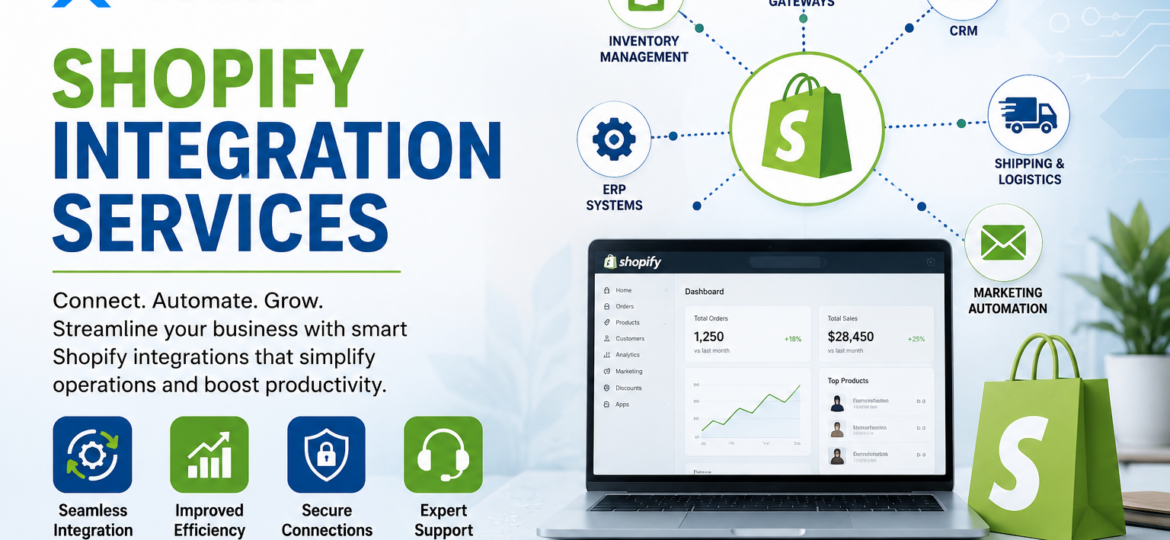
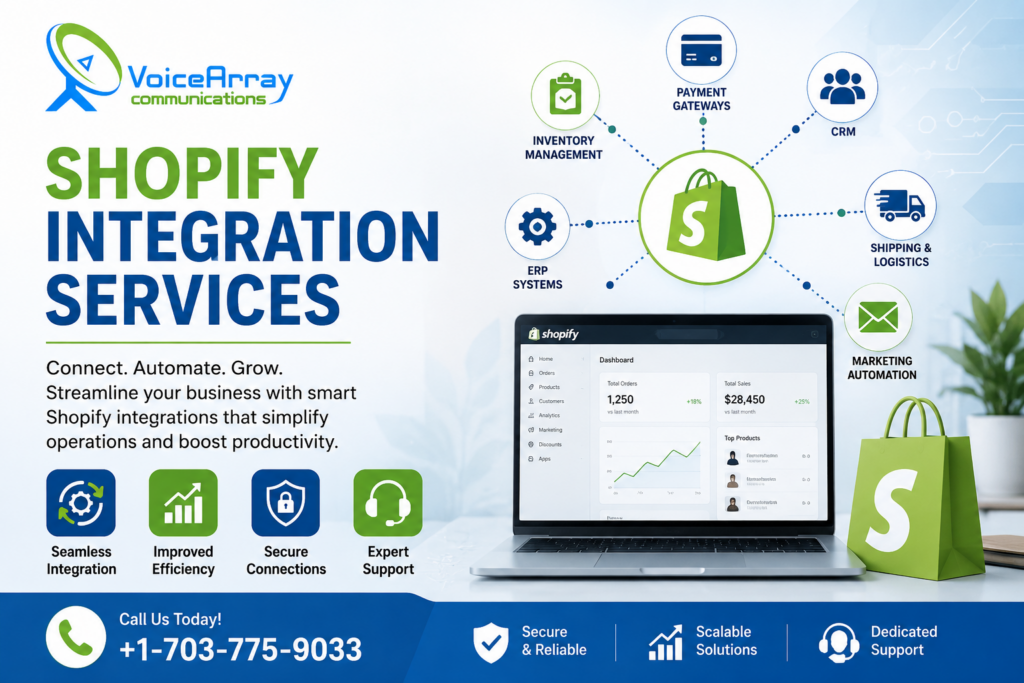
Shopify Integration Services help businesses connect their Shopify stores with essential tools, applications, payment gateways, inventory systems, CRMs, ERPs, shipping platforms, and marketing software. As online commerce continues to evolve in 2025, businesses need connected systems that reduce manual work, improve customer experiences, and support long-term growth.
Whether you’re launching a new online store or upgrading an existing one, Shopify Integration creates a unified ecosystem where every business process works together. At VOICEARRAY, we help businesses implement reliable Shopify integrations that improve efficiency, reduce operational complexity, and support scalable eCommerce growth.
Why Shopify Integration Services Matter
Modern eCommerce businesses use multiple software solutions to manage products, orders, payments, inventory, shipping, customer communication, accounting, and marketing. Without proper integration, businesses often face:
- Duplicate data entry
- Inventory mismatches
- Delayed order processing
- Customer information errors
- Higher operational costs
- Reduced productivity
Professional Shopify Integration Services eliminate these issues by allowing different platforms to communicate automatically, creating accurate workflows across your business.
What Are Shopify Integration Services?
Shopify Integration Services involve connecting your Shopify store with third-party applications, cloud platforms, APIs, and enterprise software to automate business operations.
These integrations enable real-time synchronization of:
- Product catalogs
- Customer information
- Inventory levels
- Orders
- Shipping updates
- Payment records
- Marketing campaigns
- Financial data
Instead of manually updating multiple systems, everything stays synchronized automatically.
Common Shopify Integration Solutions
Businesses often require different types of Shopify Integration depending on their operations.
Payment Gateway Integration
Secure payment processing is one of the most important integrations. Businesses can connect Shopify with trusted payment providers to offer multiple payment options while maintaining fast checkout experiences.
Popular integrations include:
- Stripe
- PayPal
- Authorize.Net
- Square
- Apple Pay
- Google Pay
Inventory Management Integration
Inventory synchronization helps prevent overselling and stock shortages.
Integrated inventory systems automatically update stock quantities whenever:
- Products are sold
- Returns are processed
- New inventory arrives
- Warehouse transfers occur
Real-time inventory improves customer satisfaction and operational accuracy.
CRM Integration
Customer Relationship Management systems help businesses organize customer interactions.
Connecting Shopify with CRM software enables:
- Customer segmentation
- Purchase history tracking
- Personalized marketing
- Sales reporting
- Customer support improvements
Popular CRM platforms include Salesforce, HubSpot, Zoho CRM, and Microsoft Dynamics.
ERP Integration
Growing businesses often require Enterprise Resource Planning (ERP) software.
ERP integration connects Shopify with:
- Accounting
- Purchasing
- Inventory
- Manufacturing
- Finance
- Supply chain management
This creates one centralized source of business information.
Shipping and Fulfillment Integration
Shipping integrations automate order fulfillment.
Businesses can connect Shopify with:
- UPS
- FedEx
- USPS
- DHL
- ShipStation
- EasyPost
Benefits include:
- Automatic shipping labels
- Live tracking
- Shipping rate calculation
- Faster order fulfillment
Marketing Automation Integration
Marketing integrations help businesses communicate with customers throughout their buying journey.
Common integrations include:
- Klaviyo
- Mailchimp
- ActiveCampaign
- Google Ads
- Meta Ads
- Google Analytics 4
These tools automate email marketing, remarketing campaigns, customer journeys, and performance tracking.
Benefits of Shopify Integration Services
Businesses investing in Shopify Integration Services gain measurable operational improvements.
Better Workflow Automation
Automation removes repetitive manual tasks, allowing teams to focus on customer service and business growth.
Improved Data Accuracy
Real-time synchronization reduces errors caused by manual data entry and duplicate information.
Faster Order Processing
Integrated systems automatically transfer order information between departments, reducing delays and improving customer satisfaction.
Better Customer Experience
Customers receive:
- Faster deliveries
- Accurate inventory
- Real-time tracking
- Personalized communication
- Smooth checkout experiences
These improvements contribute to stronger customer loyalty.
Scalable Business Operations
As businesses grow, integrated systems support increasing order volumes without requiring major operational changes.
Shopify Integration for Different Business Types
Every business has different integration requirements.
Retail Businesses
Retail stores often integrate Shopify with POS systems, warehouse management, inventory software, and accounting tools.
Wholesale Businesses
Wholesale companies benefit from ERP integration, bulk ordering systems, customer pricing management, and inventory synchronization.
Manufacturing Companies
Manufacturers integrate Shopify with production planning, procurement systems, inventory management, and shipping platforms.
Subscription Businesses
Subscription stores connect recurring billing software with Shopify for automated renewals and customer account management.
API-Based Shopify Integration
Many businesses require custom integrations that standard apps cannot provide.
Using Shopify APIs allows developers to create secure connections between Shopify and custom business software.
API integration can support:
- Custom dashboards
- Proprietary inventory systems
- Internal databases
- Business intelligence platforms
- Mobile applications
- Marketplace synchronization
This approach offers greater flexibility while maintaining long-term scalability.
How Professional Shopify Integration Services Work
Professional integration follows a structured implementation process.
Step 1: Business Analysis
Current workflows, software platforms, and operational goals are reviewed to identify integration requirements.
Step 2: Integration Planning
Developers create an integration strategy that minimizes disruptions while supporting future growth.
Step 3: API Configuration
Required APIs, middleware, and third-party applications are configured securely.
Step 4: Data Migration
Products, customers, orders, and inventory are synchronized between systems.
Step 5: Testing
Comprehensive testing verifies that every workflow performs correctly before deployment.
Step 6: Ongoing Support
Continuous monitoring, maintenance, and updates help maintain long-term reliability.
Shopify Integration Best Practices in 2025
Businesses should follow current best practices to maximize integration performance.
- Use secure API authentication.
- Choose scalable cloud-based solutions.
- Maintain regular software updates.
- Monitor synchronization logs.
- Back up business data.
- Limit unnecessary third-party applications.
- Perform routine integration testing.
- Prioritize customer data security.
These practices align with current eCommerce development standards and improve long-term platform stability.
Why Choose VOICEARRAY for Shopify Integration Services?
At VOICEARRAY, we understand that every online business has unique operational requirements. Our Shopify Integration Services are designed to connect your Shopify store with the tools your business depends on while maintaining security, performance, and scalability.
Our approach includes:
- Custom Shopify Integration solutions
- Secure API development
- Third-party application integration
- CRM and ERP connectivity
- Payment gateway integration
- Inventory synchronization
- Shipping automation
- Ongoing technical support
Our development team focuses on building reliable integrations that improve operational efficiency while supporting future business growth.
Industry Insights and Trusted References
According to Shopify’s developer documentation, API integrations allow businesses to extend store functionality and automate complex workflows across multiple business systems. Similarly, Google’s Search Central recommends creating fast, user-focused websites with structured content and reliable technical implementation to improve user experience and visibility in search results.
These industry standards reinforce the importance of secure, scalable, and well-maintained Shopify integrations.
FAQ
1. What are Shopify Integration Services?
Shopify Integration Services connect your Shopify store with external software such as CRM systems, ERP platforms, payment gateways, inventory management tools, and shipping providers. These integrations automate workflows, improve data accuracy, and reduce manual work across your business.
2. Why is Shopify Integration important for growing businesses?
Shopify Integration allows businesses to synchronize inventory, orders, customer information, and financial data automatically. This reduces operational errors, speeds up order processing, improves customer experiences, and supports scalable business growth without increasing manual workload.
3. Can Shopify Integration Services connect with custom business software?
Yes. Professional Shopify Integration Services can use Shopify APIs to connect with custom applications, proprietary databases, ERP systems, mobile apps, and enterprise platforms. This creates flexible workflows tailored to your business requirements while maintaining secure data synchronization.
4. How long does Shopify Integration usually take?
The implementation timeline depends on project complexity, required applications, custom API development, and testing. Simple integrations may take a few days, while enterprise-level Shopify Integration projects involving multiple systems can require several weeks for planning, development, and deployment.
Conclusion
Modern eCommerce businesses rely on connected systems to remain efficient and competitive. Shopify Integration Services help automate operations, improve data accuracy, enhance customer experiences, and create scalable workflows that support long-term business success. Whether you need payment processing, inventory synchronization, CRM connectivity, ERP integration, or custom API development, choosing the right integration strategy can significantly improve your online operations.
At VOICEARRAY, we deliver secure, scalable, and customized Shopify Integration solutions designed around your business goals. If you’re ready to streamline your Shopify store and improve operational efficiency, contact VOICEARRAY today to discuss your integration requirements and build a smarter eCommerce ecosystem.