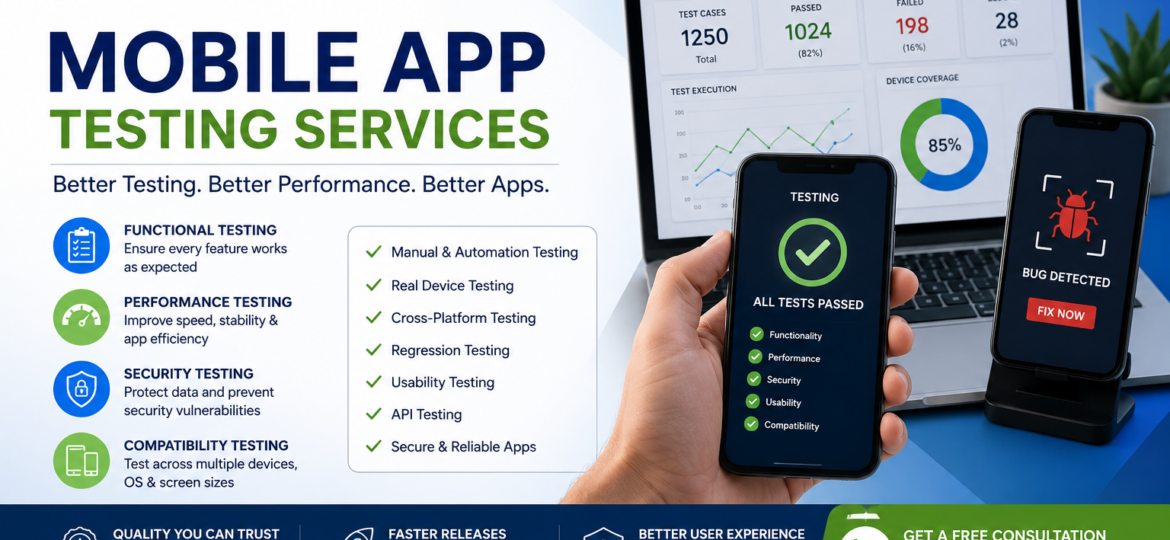
Mobile App Testing Services are essential for businesses that want to deliver secure, high-performing, and user-friendly mobile applications. Whether you’re launching a new Android app, an iOS application, or a cross-platform solution, comprehensive testing helps eliminate bugs, improve user satisfaction, and reduce costly post-launch fixes.
As mobile technology continues to evolve in 2025, users expect applications to load quickly, function flawlessly, and protect their personal information. Even a small issue can lead to negative reviews, lower app ratings, and lost business opportunities. At VOICEARRAY, we provide comprehensive Mobile App Testing Services designed to help businesses release reliable applications with confidence.
Why Mobile App Testing Matters
Mobile users have little patience for applications that crash, freeze, or perform inconsistently. Studies from organizations such as Google Android Developers and Apple Developer Documentation consistently emphasize quality assurance, performance optimization, and usability testing before deployment.
Professional Mobile App Testing Services help organizations:
- Detect bugs before release
- Improve application stability
- Verify security measures
- Enhance user experience
- Ensure compatibility across devices
- Reduce maintenance costs
- Increase customer satisfaction
Testing is no longer just a development step—it is a critical business investment.
What Are Mobile App Testing Services?
Mobile App Testing Services involve evaluating a mobile application under different conditions to ensure it functions correctly, performs efficiently, and delivers a seamless user experience.
Testing covers every aspect of the application, including:
- Functionality
- Performance
- Security
- Compatibility
- Accessibility
- User interface
- User experience
- Network behavior
- Installation and updates
The goal is to identify defects before users experience them.
Types of Mobile App Testing
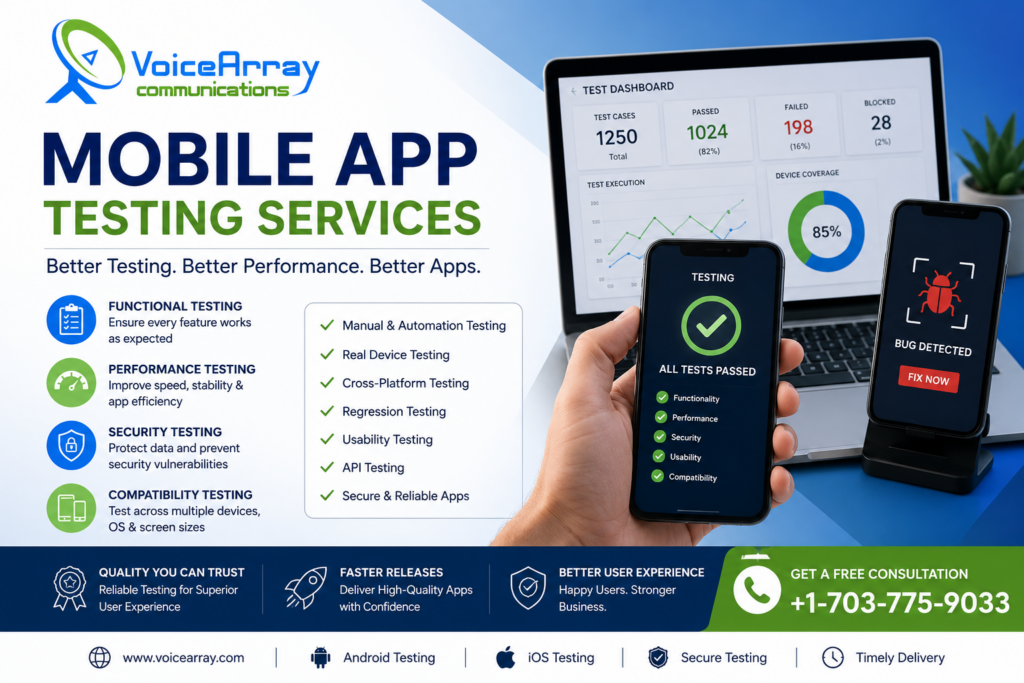
Functional Testing
Functional testing verifies that every feature works exactly as intended.
This includes:
- User registration
- Login systems
- Payment processing
- Navigation
- Notifications
- Forms
- API integrations
Each workflow is tested to ensure expected results under different scenarios.
Performance Testing
Users expect fast applications regardless of their device.
Performance testing evaluates:
- App launch speed
- Response time
- Memory consumption
- CPU usage
- Battery impact
- Network performance
- Load handling
Optimizing these areas creates a smoother user experience.
Security Testing
Mobile applications often process sensitive customer information.
Security testing identifies vulnerabilities such as:
- Weak authentication
- Data leakage
- Insecure APIs
- Encryption issues
- Session management flaws
- Permission misuse
A secure application builds user confidence and protects business data.
Compatibility Testing
Modern applications must perform consistently across hundreds of devices.
Compatibility testing checks:
- Android versions
- iOS versions
- Tablets
- Smartphones
- Different screen sizes
- Various manufacturers
- Multiple operating systems
This ensures consistent performance regardless of the user’s device.
Usability Testing
Even technically perfect applications can fail if users find them confusing.
Usability testing evaluates:
- Navigation
- Interface design
- Accessibility
- User flow
- Readability
- Interaction patterns
The objective is making the application intuitive for every user.
Regression Testing
Whenever developers introduce new features or updates, existing functionality can unexpectedly break.
Regression testing confirms previous features continue working after changes, helping maintain long-term application stability.
Manual vs Automated Mobile App Testing
Both approaches play an important role.
| Manual Testing | Automated Testing |
| Human evaluation | Script-based testing |
| Better for usability | Faster repetitive testing |
| Flexible | Highly scalable |
| Detects visual issues | Excellent for regression testing |
Most successful projects combine both methods to maximize software quality.
Industries That Benefit from Mobile App Testing
Professional Mobile App Testing Services support organizations across many industries, including:
- Healthcare
- Banking and finance
- Retail
- Education
- Logistics
- Manufacturing
- Hospitality
- Government
- Insurance
- Real estate
Every industry requires reliable applications that perform consistently under real-world conditions.
Common Problems Testing Can Prevent
Without comprehensive testing, applications may experience:
- Unexpected crashes
- Slow loading screens
- Payment failures
- Login issues
- Broken navigation
- Device incompatibility
- Security vulnerabilities
- Data synchronization problems
- Poor battery performance
- Network timeout errors
Early detection significantly reduces long-term development costs.
Mobile App Testing Process at VOICEARRAY
At VOICEARRAY, our testing process follows industry-recognized quality assurance practices while adapting to each project’s unique requirements.
Requirement Analysis
We understand application goals, business requirements, user expectations, and technical specifications.
Test Planning
Our quality assurance team develops a detailed testing strategy covering functionality, performance, security, compatibility, and usability.
Test Case Development
Comprehensive test cases are created to validate every important feature and user workflow.
Test Execution
Applications are tested across multiple real devices, emulators, operating systems, browsers, and network environments.
Bug Reporting
Every identified issue is documented with clear reproduction steps, screenshots, severity levels, and recommendations.
Retesting
After fixes are implemented, affected areas are retested to verify successful resolution.
Final Quality Validation
A final review confirms the application is ready for production deployment.
Key Benefits of Professional Mobile App Testing Services
Businesses that invest in quality assurance often experience measurable improvements.
Benefits include:
- Better customer satisfaction
- Higher App Store ratings
- Improved Google Play reviews
- Lower maintenance costs
- Reduced production bugs
- Faster release cycles
- Better application security
- Increased customer retention
- Higher business credibility
- Greater operational efficiency
Reliable applications encourage long-term customer engagement.
Mobile App Testing Best Practices in 2025
Modern testing extends beyond identifying software defects.
Current best practices include:
- Continuous testing throughout development
- AI-assisted defect detection
- Real device testing
- Cloud testing environments
- Shift-left quality assurance
- Security-first testing
- Accessibility compliance
- Automated regression testing
- API validation
- Performance monitoring after deployment
Organizations adopting these practices can release applications more confidently while maintaining high quality standards.
Why Choose VOICEARRAY for Mobile App Testing Services?
VOICEARRAY helps organizations deliver dependable mobile applications through structured quality assurance processes, experienced testing professionals, and modern testing methodologies.
Our approach emphasizes:
- Comprehensive quality validation
- Transparent reporting
- Cross-platform testing
- Scalable testing strategies
- Business-focused quality assurance
- Security-conscious testing
- Continuous improvement
Our objective is helping businesses launch applications that users can trust.
FAQ
What are Mobile App Testing Services?
Mobile App Testing Services evaluate mobile applications for functionality, security, performance, compatibility, and usability before release. Comprehensive testing helps identify defects early, reduces development costs, improves customer satisfaction, and ensures applications perform reliably across Android, iOS, tablets, and various mobile devices.
Why are Mobile App Testing Services important?
Professional Mobile App Testing Services reduce the risk of crashes, security vulnerabilities, poor performance, and compatibility issues. Thorough testing protects your brand reputation, enhances user experience, supports app store approval, and helps businesses release stable applications that meet customer expectations and industry standards.
How long does Mobile App Testing take?
The testing timeline depends on application complexity, available features, supported platforms, integrations, and testing scope. Small applications may require only a few days, while enterprise applications with multiple modules and security requirements often require several weeks of structured testing.
What types of testing should every mobile application include?
Most applications should include functional testing, performance testing, compatibility testing, security testing, usability testing, regression testing, and installation testing. Combining these testing methods provides comprehensive quality assurance and helps ensure a stable user experience across different devices and operating systems.
Conclusion
High-quality mobile applications are built through continuous improvement, careful validation, and comprehensive testing. Investing in professional Mobile App Testing Services reduces risks, improves application performance, strengthens security, and delivers a better experience for users.
Whether you’re developing a new application or enhancing an existing one, quality assurance remains one of the most valuable investments throughout the software development lifecycle.
VOICEARRAY provides dependable Mobile App Testing Services designed to help businesses launch applications with greater confidence, reliability, and long-term performance.
Contact VOICEARRAY today to learn how our testing solutions can help ensure your next mobile application meets modern quality standards.