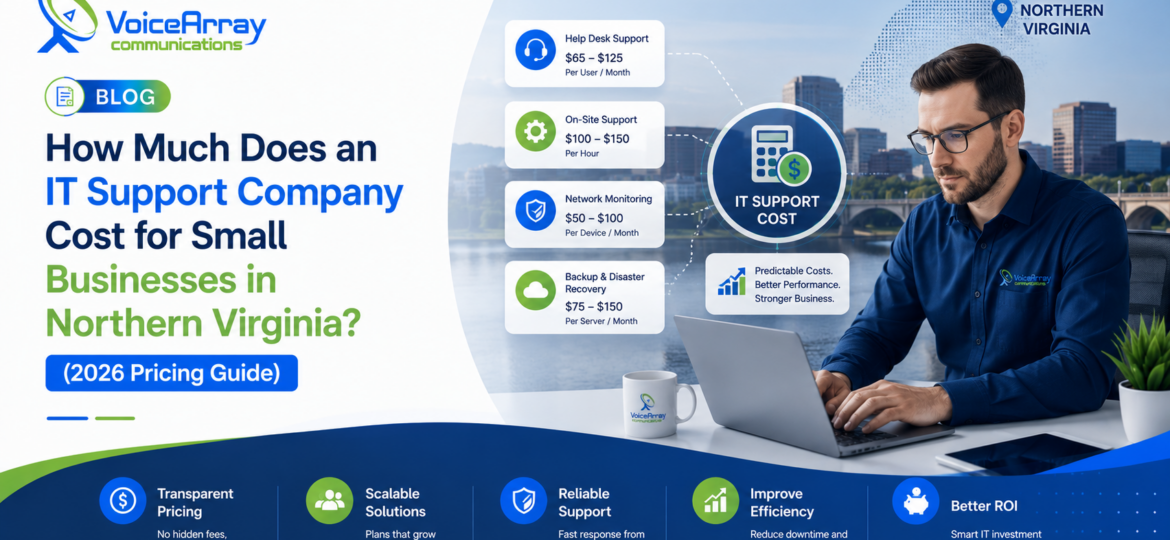
An IT support company typically charges small businesses in Northern Virginia between $100 and $250 per user per month, or a flat fee of $1,500 to $5,000 per month for a 10- to 50-employee company. Where you land in that range depends on how many devices you have, whether you need 24/7 coverage, and how much cybersecurity and compliance work your business requires.
If you are a small business owner, startup founder, or operations manager trying to budget for IT in 2026, that range probably raises more questions than it answers. Why does one provider quote $100 a month while another quotes $300? What’s actually included? And is a flat-rate IT service provider company a better deal than paying by the hour when something breaks?
This guide breaks down real 2026 pricing models, what drives the cost up or down, and how to tell a fair quote from one that is hiding fees. As a managed IT services and IT consulting provider serving Northern Virginia businesses directly, including Springfield and the greater DC metro area, Voice Array put this guide together using current market pricing data so local business owners can budget with real numbers instead of guesswork.
What Does IT Support Actually Cost in 2026?
Across the United States, managed IT services generally run $100 to $250 per user per month for small businesses, with some premium, compliance-heavy plans reaching $400 per user. For a typical 10- to 50-employee company, that translates to a flat monthly bill between $1,500 and $5,000.
Here is how that breaks down by company size:
| Company Size | Typical Monthly Cost | Per-User Rate |
| 10 employees | $1,500 – $3,000 | $150 – $300 |
| 25 employees | $3,000 – $7,500 | $120 – $300 |
| 50 employees | $5,000 – $15,000 | $100 – $300 |
These numbers reflect standard, well-secured managed IT plans. A healthcare practice, law firm, or any business with compliance obligations should expect to land toward the higher end, since meeting frameworks like HIPAA adds extra monitoring, documentation, and audit work that increases the provider’s costs.
The Three Main IT Support Pricing Models
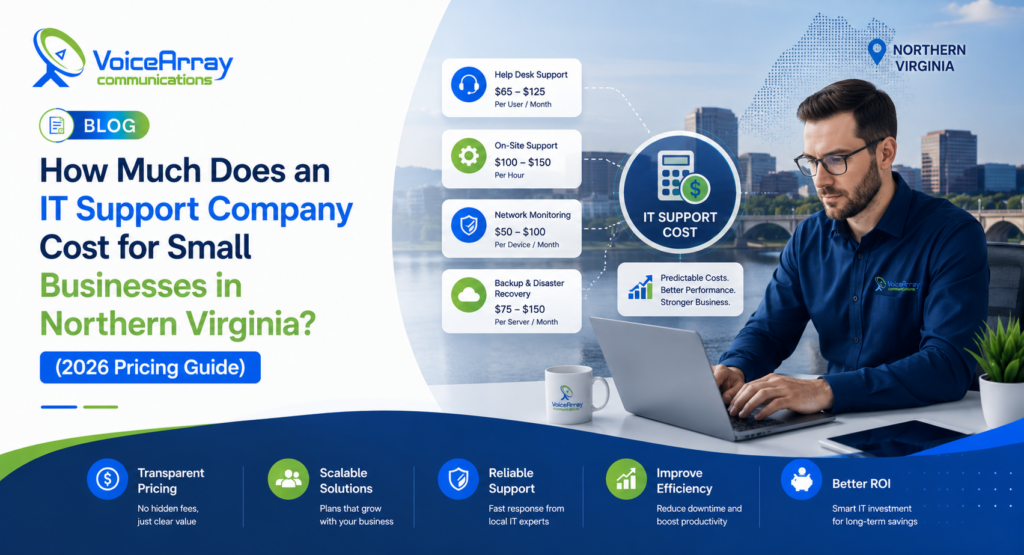
Not every IT service provider company prices the same way. Understanding the model behind a quote matters more than comparing the dollar figure alone, since two providers quoting different numbers may be offering very different scopes of work.
Per-User Pricing
This is the most common model for small business IT support today. The provider charges a flat fee for every employee who uses a device for work, regardless of how many devices that person has. Per-user pricing typically runs $100 to $250 per user per month and includes help desk support, endpoint security, and basic productivity platform management for tools like Microsoft 365.
This model works well when your team size is stable, and your support needs are fairly even across employees.
Flat-Rate (All-Inclusive) Pricing
Instead of a per-user fee, some IT consulting firms offer one predictable monthly number that covers help desk, security, backups, and strategic planning under a single line item. For a 10- to 50-person business, flat-rate plans typically run $1,500 to $5,000 per month. This model is popular with small businesses that want a fixed line item for budgeting rather than a number that shifts with headcount or ticket volume.
Break-Fix (Hourly) Pricing
The oldest model: you call when something breaks, and you pay by the hour, typically $100 to $250 per hour. It looks cheaper on paper because you only pay when there’s a problem. In practice, break-fix providers have no financial incentive to prevent issues, since they profit when things go wrong. There’s no proactive network monitoring, no patching schedule, and no one watching your backups. A single outage or ransomware incident can erase years of apparent monthly savings, and recent industry data puts the average ransomware recovery cost in the tens of thousands of dollars for a small business.
What Actually Drives Your IT Support Quote Up or Down
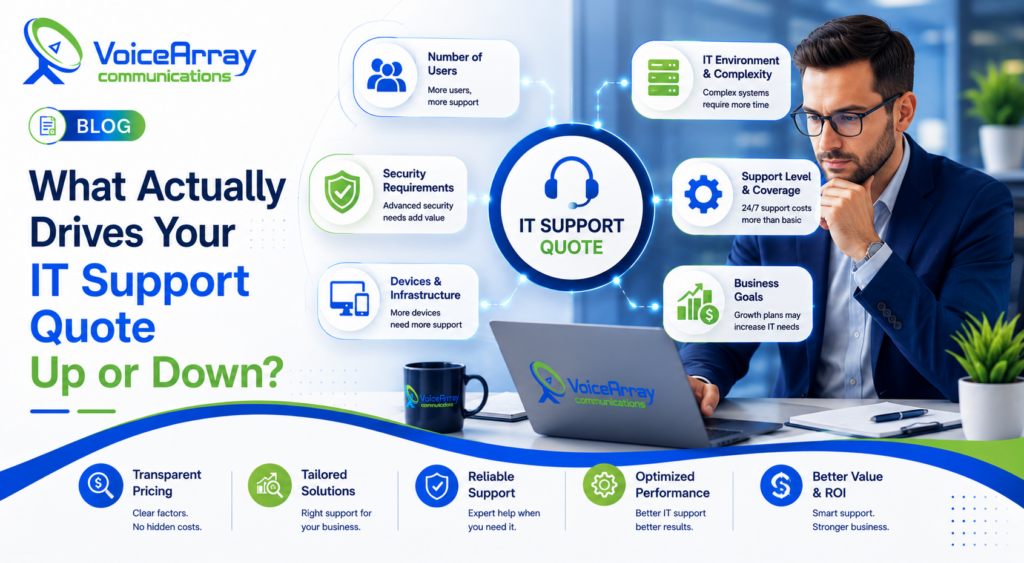
If you’ve gotten quotes that vary by a thousand dollars or more for what sounds like the same service, it’s almost always one of these five factors.
Company size and device count.
More users and more devices to monitor and patch means more work for the provider, though per-seat pricing usually drops slightly as headcount grows due to volume discounts.
Cybersecurity depth.
Basic monitoring sits at the low end of pricing. Plans that add endpoint detection and response, a security operations team, and proactive threat hunting push costs toward the premium tier, often $200 to $300 per user per month.
Compliance requirements.
Businesses in regulated industries, such as healthcare, legal services, or financial services, should expect compliance work to add 20 to 30 percent on top of standard rates. This covers the audits, documentation, and encryption standards those frameworks require.
Support hours and response time.
A provider guaranteeing a 30-minute response time around the clock has to staff more capacity than one offering next-business-day support during office hours only. Business-hours-only contracts typically cost 15 to 25 percent less than full 24/7 coverage.
What’s actually included.
This is the factor most small business owners underestimate. A $75 per user quote that excludes security tools, after-hours support, or onsite visits is not actually cheaper than a $175 quote that includes everything; it just defers the cost until something goes wrong.
Managed IT vs. In-House IT: Which Costs Less?
For most businesses under 50 employees, outsourcing IT support costs meaningfully less than building an internal team. A single in-house IT hire costs roughly $85,000 to $120,000 per year once you include salary, benefits, and overhead, and one person rarely covers the full range of skills a modern business needs across networking, cybersecurity, and cloud administration.
By comparison, a managed IT support contract for a 20-person company typically runs $42,000 to $54,000 per year, and that buys access to a full team of specialists rather than one generalist. This is one of the clearest ROI arguments for outsourcing IT support, particularly for startups and small businesses that can’t yet justify a full internal IT department.
What Should Be Included in a Fair IT Support Quote
Before signing with any IT support company, confirm the contract clearly states what’s covered. A solid small business IT support plan should generally include:
Remote IT support and help desk access for day-to-day issues, ongoing network monitoring services to catch problems before they cause downtime, endpoint security and patch management, regular data backup and recovery procedures, and a clear disaster recovery plan in case of a major outage. Cloud administration for platforms like Microsoft 365 or AWS should also be spelled out, along with the guaranteed response time for urgent issues.
If a quote doesn’t clearly define these items, ask directly. The cheapest quote is rarely the best value once you account for what’s missing.
Why Local Context Matters for IT Support Pricing in Northern Virginia
National averages are a useful starting point, but Northern Virginia has its own dynamics worth factoring into your budget. The region’s concentration of government contractors, defense-adjacent businesses, and regulated industries means compliance-aware IT support is in higher demand here than in many other markets, which can push quotes toward the upper half of national ranges for businesses that need that expertise. At the same time, the density of small businesses and startups across Springfield, Fairfax, and the greater DC metro area means there’s real competition among local providers, which works in favor of business owners who get multiple quotes rather than accepting the first one.
A local IT service provider company also has an advantage that a remote-only provider doesn’t: the ability to send someone onsite the same day when remote troubleshooting isn’t enough.
FAQs
How much does IT support cost for a small business per month?
Most small businesses pay between $1,500 and $5,000 per month for managed IT support, depending on headcount and service depth. On a per-user basis, expect $100 to $250 per employee per month for a standard, well-secured plan.
Is managed IT support cheaper than hiring an in-house IT person?
For businesses under 50 employees, yes, almost always. A single in-house IT hire costs $85,000 to $120,000 per year fully loaded, while a managed IT support company typically costs $42,000 to $54,000 per year for a 20-person business and includes a full team of specialists.
What’s the difference between per-user and flat-rate IT support pricing?
Per-user pricing charges a fixed fee for each employee, which scales naturally as you grow. Flat-rate pricing charges one predictable monthly amount regardless of headcount changes within the plan. Flat-rate pricing is often easier to budget around, while per-user pricing is more common industry-wide.
Why do IT support quotes vary so much between providers?
Quotes usually differ because providers bundle different services. A lower quote may exclude cybersecurity tools, after-hours support, or onsite visits, while a higher quote includes them. Always compare scope, not just the monthly number.
Does compliance, like HIPAA, increase IT support costs?
Yes. Businesses with compliance obligations should expect to pay 20 to 30 percent more than standard rates, since meeting these frameworks requires extra audits, documentation, and security controls.
Is break-fix IT support a good option for small businesses?
Break-fix can look cheaper month to month since you only pay when something breaks, typically $100 to $250 per hour. However, it offers no proactive monitoring or prevention, so a single major outage or security incident often costs more than a year of managed IT support would have.
Conclusion:
IT support pricing for small businesses in Northern Virginia generally falls between $100 and $250 per user per month, or $1,500 to $5,000 per month as a flat fee for a typical 10- to 50-employee company. The right number for your business depends on your headcount, security needs, compliance requirements, and how quickly you need a response when something goes wrong.
The most expensive mistake isn’t overpaying for IT support. It’s underpaying for a plan that leaves gaps in security and backup, and finding out the hard way during an outage. If you’d like a clear, no-pressure quote based on your actual business size and needs, contact Voice Array today, and we’ll walk you through exactly what’s included and why.