

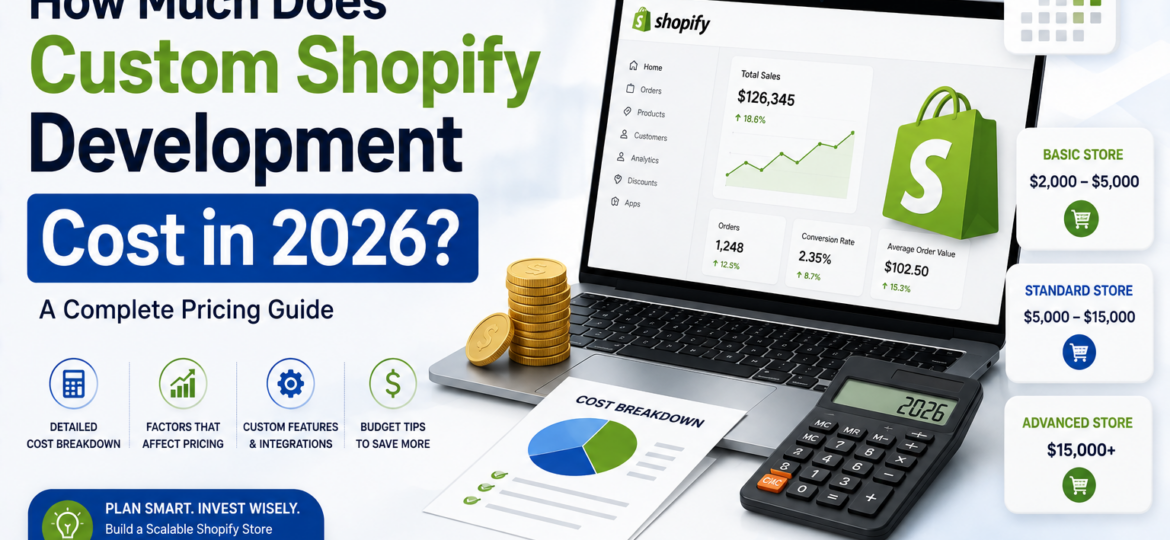
Custom Shopify Development can cost anywhere from a relatively small customization project to a substantial ecommerce implementation, depending on your design, functionality, integrations, product catalog, and long-term business requirements.
For small businesses, startups, restaurants, spas, growing ecommerce brands, and enterprise organizations, the bigger question is not simply “How much does Shopify development cost?” It is “What level of Shopify customization does my business actually need?”
In 2026, Shopify provides a mature ecommerce ecosystem that supports custom themes, Shopify Liquid, APIs, apps, advanced storefront experiences, Shopify Plus, and international selling through Shopify Markets. That flexibility makes Shopify suitable for businesses ranging from new startups to complex ecommerce operations.
This guide explains the major factors behind custom Shopify development cost, what you should expect to pay for different project types, and how to decide whether a custom Shopify website is worth the investment.
Custom Shopify Development Cost at a Glance
There is no universal price for custom Shopify development because every project has a different scope.
As a practical planning framework, businesses can think about development budgets in these broad ranges:
| Project Type | Typical Planning Budget | Best For |
| Basic Shopify customization | $1,500–$5,000+ | Small businesses and simple stores |
| Custom Shopify design | $5,000–$12,000+ | Brands needing a unique storefront |
| Custom Shopify store development | $10,000–$25,000+ | Growing ecommerce businesses |
| Advanced Shopify development | $20,000–$50,000+ | Complex functionality and integrations |
| Shopify Plus development | $30,000–$100,000+ | Enterprise and high-volume businesses |
These are planning ranges rather than fixed industry prices or Shopify fees. The final quote depends on the number of templates, custom features, integrations, product complexity, migration requirements, testing, and post-launch support.
Shopify’s own platform subscription is a separate expense. For example, Shopify’s current published pricing lists different plans for different business sizes, with Shopify Plus positioned for more advanced commerce requirements.
What Is Custom Shopify Development?
Custom Shopify development means building or modifying a Shopify store beyond basic theme settings and standard configuration.
A project may involve custom theme development, Shopify app development, API integration, responsive web design, custom functionality, third-party integrations, or specialized ecommerce workflows.
Shopify themes control the look and feel of an online store, and Shopify officially supports theme customization and the creation of bespoke themes for merchants with specific requirements.
For example, a small business may only need a custom homepage and product pages. A larger company may require a completely customized e-commerce platform connected to its CRM, ERP, inventory management system, payment processing infrastructure, and customer management tools.
That difference in scope is why two businesses can receive very different Shopify development quotes.
What Affects Shopify Store Development Pricing?
Several variables influence the final cost of a custom Shopify project.
1. Custom Shopify Design
Design is one of the first major cost factors.
A business using an existing Shopify theme with limited changes generally needs less development than a company requesting a unique storefront.
Custom Shopify design may include:
- Custom homepage layouts
- Product page design
- Collection page design
- Mobile-first layouts
- Conversion-focused navigation
- Custom landing pages
- Brand-specific components
- Responsive web design
Shopify themes are built using Liquid along with technologies such as HTML, CSS, JavaScript, and JSON, allowing developers to create highly customized storefront experiences.
2. Custom Functionality
The more functionality your store requires, the more development work is involved.
Examples include custom product configurators, subscription workflows, wholesale pricing, product personalization, advanced filtering, custom shipping rules, customer portals, and specialized checkout experiences.
A store that only needs standard ecommerce functionality can therefore be considerably less expensive than one requiring several custom business workflows.
3. Shopify Apps and the Shopify App Store
The Shopify App Store can reduce development time because businesses can use existing applications instead of building every feature from scratch.
However, adding too many apps can create additional subscription costs, dependencies, performance concerns, or compatibility issues.
A Shopify developer should evaluate whether an existing app, native Shopify feature, or custom Shopify solution is the best option for each requirement.
Sometimes the cheapest short-term solution is not the most efficient long-term solution.
4. Shopify APIs and Integrations
API integration can significantly affect development pricing.
Shopify provides APIs and developer tools for building applications, managing store data, and creating custom commerce experiences. Its developer platform includes the GraphQL Admin API, Storefront API, and tools for building apps and storefronts.
Businesses may need integrations with:
- CRM systems
- ERP platforms
- Accounting software
- Inventory management systems
- Shipping platforms
- Payment providers
- Marketing automation
- Customer support software
- Business intelligence tools
For example, a restaurant brand operating multiple locations may need Shopify connected to inventory, customer management, marketing, and order management systems. A growing B2B company may require custom pricing and ERP synchronization.
The more complex the data flow, authentication, synchronization, and error handling, the greater the development effort.
Shopify Liquid and Custom Theme Development
Shopify Liquid is Shopify’s template language for themes. It allows developers to dynamically render store content and create customized storefront experiences.
This is important when evaluating custom Shopify web design because a custom storefront is not simply a visual design exercise.
The developer must consider:
- Theme architecture
- Reusable components
- Product templates
- Collection templates
- Navigation
- Dynamic content
- Mobile responsiveness
- Performance
- Maintainability
Shopify also provides developer tooling such as Shopify CLI and Theme Check to support theme development and quality control.
In 2026, Shopify is also previewing new Liquid capabilities around blocks and partials, showing that the platform continues to evolve its theme development model. Existing themes continue to work while these newer capabilities are explored.
Custom Shopify Website vs. Pre-Built Theme
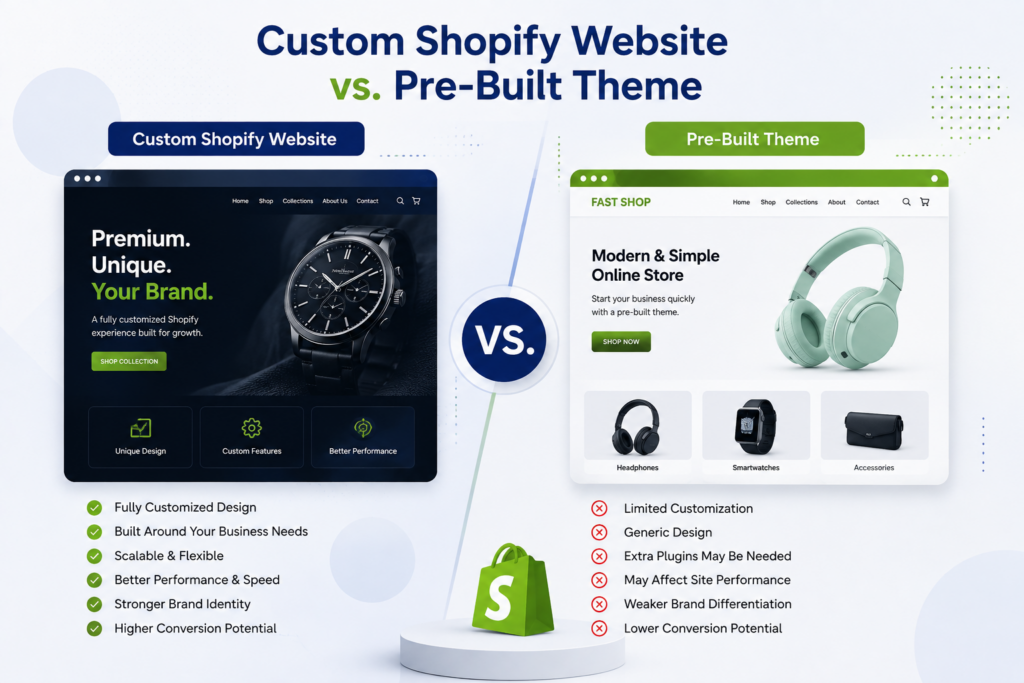
One of the biggest decisions for a business is whether it actually needs custom development.
A pre-built theme may be enough if your store has straightforward requirements and your main goal is to launch quickly.
Custom Shopify development becomes more attractive when your business needs a unique user experience, specialized functionality, complex integrations, or a storefront designed around a specific conversion strategy.
| Requirement | Pre-Built Theme | Custom Shopify Development |
| Launch speed | Faster | Usually slower |
| Initial development | Lower | Higher |
| Design flexibility | Limited to moderate | High |
| Custom functionality | Limited | High |
| Unique branding | Moderate | High |
| Advanced integrations | Depends on apps | Highly flexible |
| Scalability | Depends on setup | Designed around requirements |
The right option depends on your business goals, not simply your development budget.
How Much Does a Custom Shopify Store Cost for a Small Business?
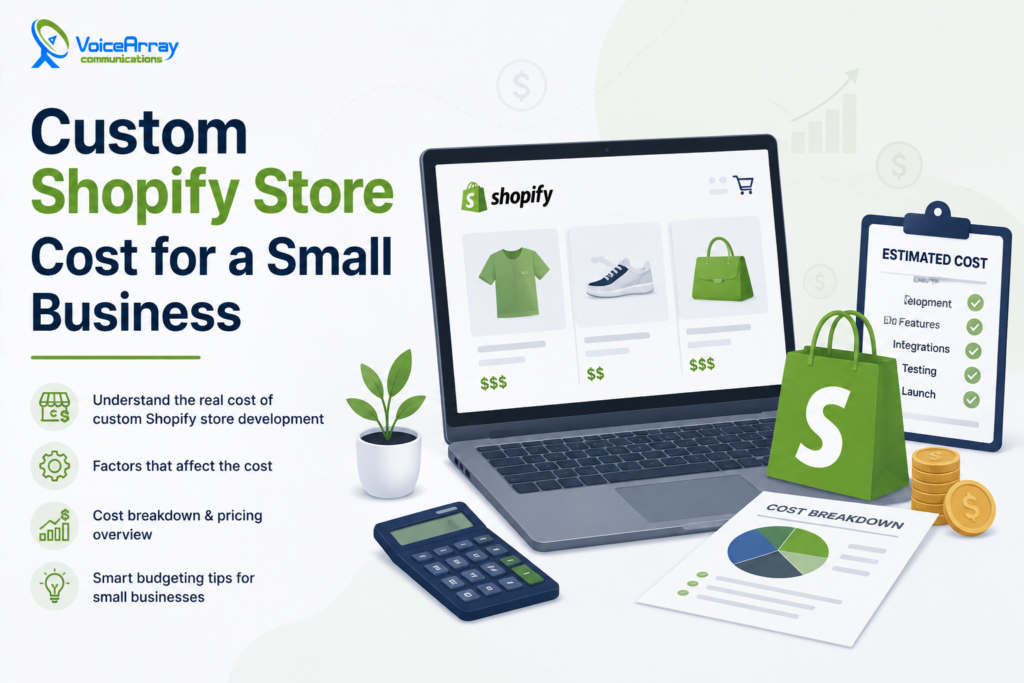
For a small business, the biggest mistake is paying for functionality it does not actually need.
A local restaurant, spa, specialty retailer, or startup may not need an enterprise-level ecommerce platform.
A smaller project might focus on:
- Custom homepage
- Product or service pages
- Mobile-responsive design
- Basic navigation
- Payment processing
- Essential Shopify apps
- Technical SEO setup
- Analytics
- Conversion-focused calls to action
A practical planning budget for this type of project may start around $1,500–$10,000+, depending on how much design and functionality is customized.
The important thing is to define the business requirements first.
How Much Does Advanced Shopify Development Cost?
Advanced projects become more expensive when they require custom applications, complex API integration, headless commerce, advanced automation, or multiple external systems.
For example, an established ecommerce business may require:
Shopify → ERP → Inventory → Order Management → Shipping → Customer Management → Analytics
Every connection introduces additional development, testing, security, and maintenance considerations.
Advanced projects can therefore move into the $20,000–$50,000+ planning range, while larger enterprise implementations may require substantially more.
The final cost should be based on technical scope rather than a generic hourly estimate.
Shopify Plus Development Cost
Shopify Plus development is typically associated with businesses that have more advanced commerce requirements.
Shopify Plus currently provides capabilities such as expanded customization, higher API limits, additional storefront capacity, advanced checkout capabilities, and enterprise-oriented features. Shopify’s current published Plus pricing starts at $2,300 per month for standard setups and integrations on a three-year term, with other pricing structures available for different requirements.
It is important to separate the Shopify Plus platform cost from the development cost.
A business may have:
Shopify Plus subscription + custom development + apps + integrations + ongoing maintenance
A Shopify Plus project can therefore require a larger initial investment, particularly when the organization needs multiple markets, custom applications, advanced integrations, or enterprise workflows.
Does Custom Shopify Development Include SEO?
It should.
SEO should not be treated as something added after development is finished.
A technically strong Shopify implementation should consider technical SEO, on-page SEO, structured data, canonical URLs, XML sitemaps, mobile-first indexing, page speed, and Core Web Vitals during development.
For example, developers should avoid creating unnecessary technical barriers that make it harder for search engines to crawl, understand, or index important ecommerce pages.
SEO considerations may include:
- Clean URL architecture
- Metadata implementation
- Heading structure
- Product structured data
- Internal linking
- Image optimization
- Canonical URLs
- XML sitemap management
- Mobile usability
- Core Web Vitals
- Page speed
This is especially important for businesses investing heavily in a custom Shopify website because redesigning technical foundations after launch can be more expensive than planning them correctly from the beginning.
Is Custom Shopify Development Worth It?
For the right business, yes.
Custom development becomes valuable when it solves a real business problem.
For example, a startup may need a differentiated shopping experience. A restaurant business may need specialized ordering workflows. A spa business may need product ecommerce combined with customer management. A growing retailer may require inventory and ERP synchronization.
An enterprise organization may need multiple markets, advanced integrations, custom applications, and scalable ecommerce infrastructure.
In each case, the value comes from matching the technology to the business.
Customization for the sake of customization is rarely a good investment.
How to Choose a Shopify Development Company
Choosing a Shopify development company should involve more than comparing the lowest quotation.
Look at the team’s technical experience, previous projects, communication process, development methodology, testing practices, and understanding of ecommerce SEO.
A qualified Shopify developer should be able to explain why a particular feature should be built, whether Shopify already supports it, whether an app can handle it, and what the long-term maintenance implications will be.
For larger organizations, ask about:
- API architecture
- Security
- Performance
- Scalability
- Integration testing
- Deployment process
- Technical SEO
- Ongoing support
A reliable ecommerce development agency should also be able to translate business requirements into a practical technical roadmap.
What Should Be Included in a Custom Shopify Development Quote?
Before approving a project, ask for a detailed scope.
A professional proposal should clarify:
Design: What pages and components are included?
Development: Which features are custom?
Integrations: Which third-party platforms will be connected?
Content: Who supplies product data, images, and copy?
SEO: Is technical SEO included?
Testing: What browsers, devices, and customer journeys will be tested?
Migration: Is existing store data being transferred?
Launch: Who manages deployment?
Support: What happens after launch?
This prevents a common problem where a low initial quote becomes expensive because important requirements were excluded.
Why VoiceArray for Custom Shopify Development?
VoiceArray approaches ecommerce development from a broader technology and business perspective rather than treating a Shopify store as just a collection of web pages.
For businesses that also need broader digital or technical support, this can be useful because ecommerce development may connect with IT Service Provider Company capabilities, Managed IT Services, SEO, website development, and ongoing technical support.
A custom Shopify project should be planned around the business’s customer journey, operational requirements, technical infrastructure, search visibility, and future growth.
For a startup, that may mean building only the features required for launch. For an established organization, it may mean creating a scalable Shopify ecosystem with custom applications, APIs, automation, and integrations.
The objective should always be the same: build what the business actually needs while keeping the platform maintainable and scalable.
Final Takeaway
So, how much does custom Shopify development cost in 2026?
A realistic planning budget can range from roughly $1,500 for simpler customizations to $100,000+ for complex enterprise Shopify implementations, depending on scope. These figures are planning ranges, not official Shopify prices.
The biggest factors are design complexity, custom functionality, Shopify apps, API integrations, product catalog complexity, SEO requirements, migration, testing, and whether the project involves Shopify Plus or headless commerce.
For small businesses and startups, the smartest strategy is usually to prioritize business-critical functionality first. Growing and enterprise businesses may benefit from deeper customization when it improves operations, customer experience, integrations, scalability, or conversion opportunities.
The right custom Shopify development investment is not necessarily the most expensive one. It is the one that gives your business the functionality, performance, flexibility, and growth foundation it actually needs.
Ready to Plan Your Shopify Project?
If you’re considering a custom Shopify website, custom Shopify design, Shopify custom development, or Shopify Plus development, VoiceArray can help you evaluate the technical scope before development begins.
Start with your business requirements, identify the functionality that matters most, and build a Shopify development roadmap around measurable business goals.
Contact VoiceArray to discuss your custom Shopify development requirements and determine the right approach for your business.
FAQs
How much does custom Shopify development cost in 2026?
Custom Shopify development can range from approximately $1,500 for basic customizations to $100,000+ for complex enterprise implementations. The final price depends on design, custom functionality, integrations, migration, SEO, testing, and Shopify Plus requirements.
What is included in custom Shopify development?
Custom Shopify development can include theme design, Liquid development, custom functionality, Shopify app development, API integration, responsive web design, third-party integrations, technical SEO, testing, migration, deployment, and post-launch support. The exact scope depends on the project.
Is custom Shopify development better than a pre-built theme?
Not always. A pre-built theme may be ideal for a startup or small business with straightforward requirements. Custom Shopify development becomes more valuable when a business needs unique branding, specialized functionality, advanced integrations, or a customer experience that standard themes cannot efficiently provide.
How much does Shopify Plus development cost?
Shopify Plus development varies according to project complexity. The development cost is separate from the Shopify Plus subscription. Shopify currently lists Plus starting at $2,300 per month for standard setups on a three-year term, while complex businesses may have different pricing arrangements.
Can Shopify support custom APIs and integrations?
Yes. Shopify provides APIs and developer tools for building applications, accessing store data, and creating custom commerce experiences. The Admin API can support backend integrations, while the Storefront API can be used for customized buyer-facing experiences.
Does custom Shopify development include SEO?
It can and ideally should. A well-planned project can incorporate technical SEO, structured data, canonical URLs, XML sitemap considerations, mobile usability, page speed, Core Web Vitals, and on-page SEO into the development process rather than treating SEO as a post-launch task.
How do I choose the right Shopify development company?
Compare Shopify experience, portfolio quality, technical capabilities, development methodology, integration expertise, SEO knowledge, testing process, communication, pricing transparency, and post-launch support. The best partner should explain the reasoning behind technical recommendations rather than simply provide the lowest quote.











[…] remember that Shopify development cost is separate from your Shopify subscription. Shopify’s current official pricing lists Basic, […]
[…] template stores cost less initially, businesses planning for long-term growth often benefit more from custom Shopify […]