

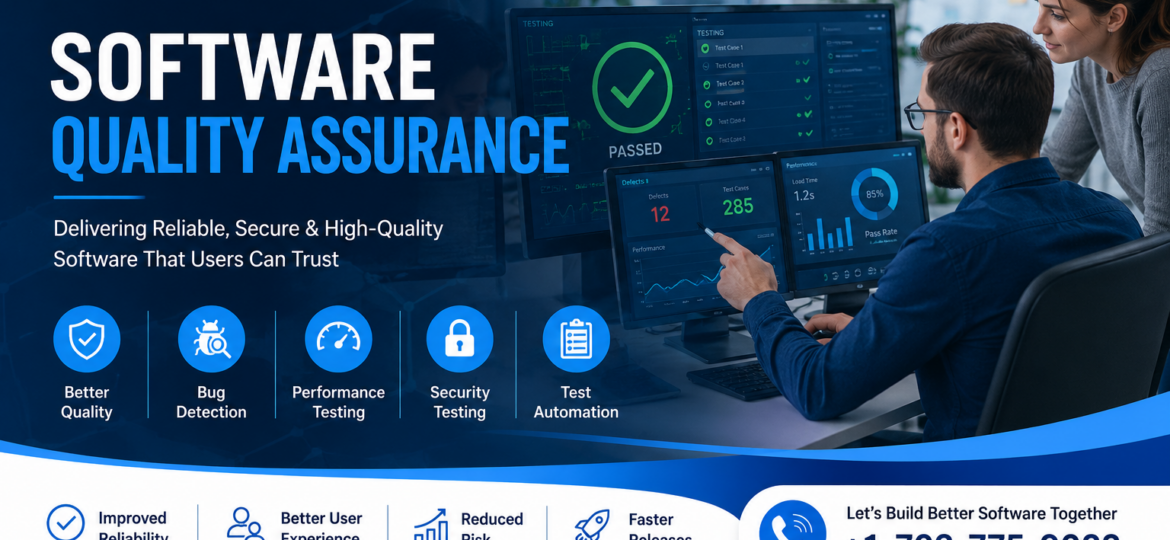
Software Quality Assurance is a structured approach to ensuring that software meets defined requirements, performs reliably, and delivers a consistent user experience. It combines quality planning, software testing, reviews, defect management, automation, security checks, and continuous improvement throughout the software development lifecycle.
For businesses building websites, mobile applications, SaaS platforms, enterprise systems, or custom software, Quality Assurance Services can help identify problems before they affect customers. Modern QA is no longer limited to finding bugs after development. It is increasingly integrated into planning, coding, deployment, security, and continuous delivery.
What Is Software Quality Assurance?
Software Quality Assurance is the process of establishing and maintaining practices that help ensure software meets specified quality requirements.
Unlike testing alone, QA covers the broader development process. It can include requirement reviews, coding standards, test planning, automated testing, security validation, performance testing, defect tracking, documentation, and release evaluation.
In simple terms, software testing asks, “Does the software work as expected?” Software Quality Assurance asks a broader question: “Are we using effective processes to consistently build software that works as expected?”
NIST maintains software assurance and testing research focused on methods, tools, evaluation, and software quality measurement.
Why Software Quality Assurance Matters
Software failures can affect revenue, customer satisfaction, productivity, security, and brand reputation. A small defect in a checkout process, login system, payment workflow, or mobile application can create significant problems when it reaches production.
Quality Assurance Services help development teams identify issues earlier and create repeatable processes for evaluating software quality.
The major benefits include:
- Improved software reliability
- Earlier identification of defects
- Better user experience
- Reduced release risk
- Improved application security
- More consistent performance
- Greater confidence during deployment
- Better alignment between requirements and the final product
QA is particularly important for applications that handle customer information, payments, business processes, or sensitive data.
NIST guidance also emphasizes testing early and throughout the software development lifecycle because verification is an important part of building secure software.
Software Quality Assurance vs. Software Testing
Software Quality Assurance and software testing are closely related, but they are not identical.
Software testing primarily evaluates the software to identify defects, unexpected behavior, and failures.
Software Quality Assurance takes a wider process-oriented approach. It focuses on how software is planned, developed, reviewed, tested, released, and maintained.
For example, a QA process may include reviewing requirements before development begins, defining acceptance criteria, preparing test scenarios, monitoring defects, performing regression testing, and analyzing release quality.
Testing is therefore an important part of QA, but QA extends beyond testing.
Key Components of Software Quality Assurance
 A modern QA process typically combines several activities rather than depending on a single testing method.
Requirement Analysis
QA can begin before the first line of code is written. Reviewing requirements helps identify ambiguity, missing information, conflicting specifications, and unrealistic expectations.
Clear requirements provide a stronger foundation for creating test cases and acceptance criteria.
Functional Testing
Functional testing verifies whether application features behave according to their requirements.
Examples include:
- User registration
- Login and authentication
- Search functionality
- Shopping carts
- Payment workflows
- Forms
- Notifications
- User dashboards
- API functionality
The goal is to verify that expected inputs produce the expected behavior.
Regression Testing
Regression testing checks whether recent code changes have unintentionally affected existing functionality.
This is especially important for applications that receive frequent updates. Automated regression tests can help development teams repeat critical checks after new releases.
Performance Testing
Performance testing evaluates how software behaves under different workloads.
It can examine:
- Response times
- Concurrent users
- Server capacity
- Application stability
- Resource consumption
- Scalability
Performance issues can become more visible as an application gains users, transactions, or data.
Security Testing
Security testing evaluates software for vulnerabilities and weaknesses that could expose systems or data.
Depending on the application, security QA may include authentication testing, authorization checks, input validation, vulnerability assessments, API security testing, and other verification techniques.
NIST’s software assurance work includes testing and methods designed to identify security-related weaknesses and improve software assurance.
Usability Testing
A technically functional application can still frustrate users if its interface is confusing.
Usability testing evaluates how easily users can navigate, understand, and complete important tasks. It can reveal problems involving navigation, forms, content, mobile layouts, accessibility, and user workflows.
Modern Quality Assurance Practices
Software development has changed significantly with Agile development, DevOps, cloud platforms, continuous integration, and automated deployment.
As a result, QA increasingly operates throughout the development lifecycle instead of being treated as a final checkpoint.
Shift-Left Testing
Shift-left testing means introducing quality activities earlier in development.
Instead of waiting until an application is almost finished, teams can review requirements, write tests, perform code analysis, and validate functionality during development.
Earlier feedback can make defects easier to understand and address.
Test Automation
Test automation uses software tools and scripts to execute repeatable tests.
Automation can be valuable for regression testing, API testing, functional testing, and continuous integration workflows. However, automation does not eliminate the need for human judgment.
Human testers remain valuable for exploratory testing, usability evaluation, unusual scenarios, and assessing behavior that is difficult to automate.
The International Software Testing Qualifications Board continues to maintain internationally recognized testing terminology, training frameworks, and specialized areas including test automation.
Continuous Testing
Continuous testing integrates testing into development and deployment pipelines.
A typical workflow may involve:
Code change → Automated tests → Build validation → Security checks → Additional testing → Deployment
This approach gives teams faster feedback and can help detect defects before they reach customers.
AI-Assisted Testing
AI-assisted development is also changing how teams approach software testing. AI-based tools can help generate test cases, identify patterns, analyze logs, summarize defects, and support test maintenance.
However, AI-generated tests still require human review. Incorrect assumptions, incomplete coverage, and misleading outputs can create new risks if automated recommendations are accepted without validation.
How Quality Assurance Services Work
A structured Quality Assurance Services process commonly follows several stages.
1. Requirement Review
The QA team reviews functional and technical requirements to understand what the software should accomplish.
2. Test Planning
The team determines testing scope, priorities, environments, tools, risks, and acceptance criteria.
3. Test Case Development
Test scenarios and test cases are created around important workflows and expected outcomes.
4. Test Execution
Testers execute planned scenarios and conduct additional exploratory testing where appropriate.
5. Defect Reporting
Issues are documented with useful information such as reproduction steps, expected behavior, actual behavior, severity, and supporting evidence.
6. Retesting and Regression Testing
After developers address defects, QA verifies the fixes and checks whether related functionality remains stable.
7. Release Evaluation
Testing results are reviewed against defined quality criteria before deployment.
This process can be adapted according to the application’s size, risk level, development methodology, and business requirements.
What Makes an Effective QA Strategy?
An effective QA strategy should be practical, measurable, and aligned with business goals.
Important considerations include:
- Clearly defined requirements
- Risk-based testing priorities
- Realistic test environments
- Automated tests for repeatable scenarios
- Manual exploratory testing
- Security and performance validation
- Clear defect documentation
- Regression testing after significant changes
- Continuous monitoring after release
- Regular improvement of the QA process
No single testing technique can find every possible software defect. NIST research has also noted that exhaustive software testing is generally impractical, which makes intelligent test selection and risk-based approaches important.
Software Quality Metrics to Monitor
Measuring QA performance helps organizations understand whether their processes are working.
Useful metrics may include:
Defect density: The number of identified defects relative to software size or scope.
Defect escape rate: The number of defects discovered after release compared with defects identified before release.
Test coverage: The extent to which important functionality, requirements, or code paths are covered by testing.
Defect resolution time: How long it takes to address reported issues.
Test automation coverage: The proportion of suitable repeatable tests executed automatically.
Metrics should not be viewed in isolation. A higher number of reported defects, for example, does not necessarily mean a QA team is performing poorly. It may indicate that testing is finding problems earlier.
Choosing Software Quality Assurance Services
When evaluating a QA provider, businesses should look beyond the number of testing tools or services offered.
Consider whether the provider understands your application, users, technology stack, security requirements, release process, and business objectives.
Ask about:
- Functional and regression testing
- API and integration testing
- Mobile and web testing
- Performance testing
- Security testing
- Test automation
- Defect management
- CI/CD integration
- Documentation and reporting
- Post-release quality monitoring
A capable QA process should adapt to the product rather than forcing every project into the same testing model.
Why Choose VoiceArray for Software Quality Assurance?
At VOICEARRAY, Software Quality Assurance can be approached as an integrated part of software development rather than a final-stage activity.
The goal is to help businesses identify functional issues, improve application reliability, evaluate user-facing workflows, and create testing processes that support ongoing development.
Whether you are developing a web application, mobile app, SaaS product, enterprise platform, or custom software solution, a structured QA approach can help your team make informed release decisions.
Quality should be considered throughout the software lifecycle, from requirements and development through testing, deployment, and maintenance.
FAQ
What is Software Quality Assurance?
Software Quality Assurance is a process-oriented approach to maintaining software quality throughout development. It includes activities such as requirement reviews, test planning, software testing, defect management, security validation, performance testing, and continuous process improvement.
Why is Software Quality Assurance important?
Software Quality Assurance helps identify defects and quality risks before they affect users. It can improve reliability, security, performance, usability, and release confidence while helping development teams establish repeatable processes for building and maintaining software.
What are common Quality Assurance Services?
Common Quality Assurance Services include functional testing, regression testing, API testing, automation testing, performance testing, security testing, usability testing, mobile testing, integration testing, and continuous testing. The appropriate combination depends on the application’s requirements and risk profile.
Can Software Quality Assurance be automated?
Yes, parts of Software Quality Assurance can be automated. Automated testing is particularly useful for repeatable regression, functional, API, and integration tests. However, human evaluation remains important for exploratory testing, usability, complex scenarios, and interpreting unexpected application behavior.
Conclusion: Build Quality Into Every Release
Software Quality Assurance is more than checking software for bugs before launch. It is a continuous approach to improving how applications are designed, developed, tested, released, and maintained.
By combining requirement analysis, functional testing, automation, security validation, performance testing, regression testing, and continuous improvement, businesses can create more reliable digital products and reduce avoidable release risks.
As software becomes more connected and development cycles become faster, integrating QA throughout the development lifecycle is increasingly important.
If your business is developing a new application or improving an existing product, VOICEARRAY can help you explore a structured approach to Software Quality Assurance and Quality Assurance Services.
Contact VOICEARRAY today to discuss your software testing and QA requirements.
