Introduction
Mobile Application Development Services help businesses turn ideas into reliable, user-friendly mobile apps for customers, employees, and internal operations. From planning and UI/UX design to development, testing, deployment, and maintenance, a structured development process can make a mobile application easier to use, scale, and maintain.
Today, businesses use mobile applications for e-commerce, customer service, booking, communication, financial services, healthcare, logistics, productivity, and many other digital experiences. Choosing the right development approach therefore requires more than simply building an app. Businesses need to consider their users, platforms, security requirements, integrations, performance, and long-term goals.
This guide explains what Mobile Application Development Services include, how the process works, what technologies are commonly used, and what businesses should consider before starting a mobile application project.
What Are Mobile Application Development Services?
Mobile Application Development Services are professional services used to plan, design, build, test, launch, and maintain applications for mobile devices such as smartphones and tablets.
Depending on the project, development may focus on:
- iOS applications
- Android applications
- Cross-platform mobile applications
- Enterprise mobile applications
- E-commerce apps
- Customer-facing applications
- Internal business applications
- On-demand and booking apps
- API-connected mobile applications
A professional development process usually begins with business and user requirements before moving into design, development, quality assurance, deployment, and ongoing optimization.
What Do Mobile Application Development Services Include?
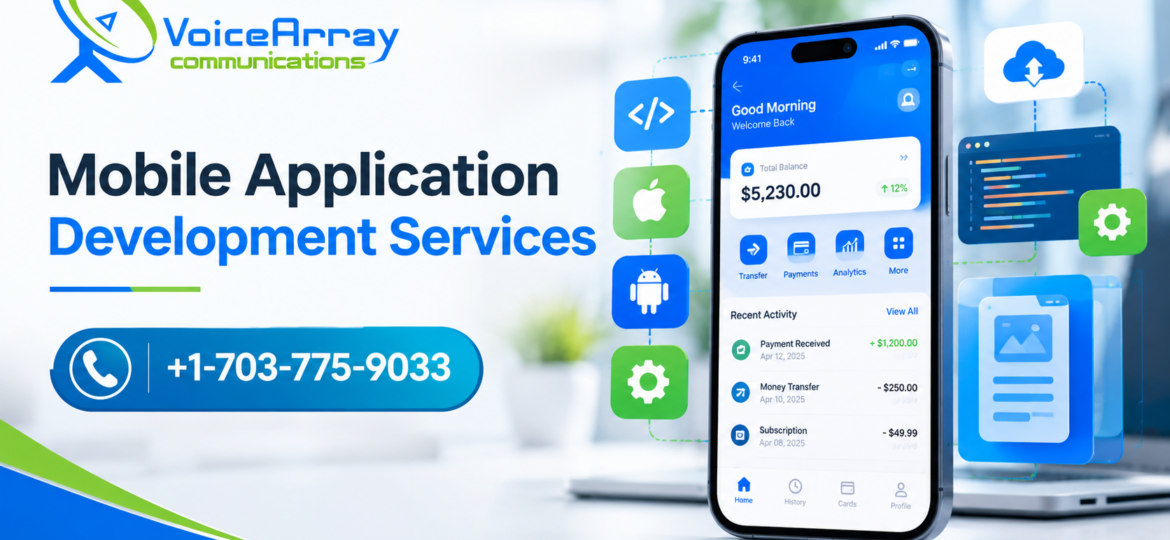
A complete mobile application project can involve several connected stages. Each stage contributes to the application’s usability, security, performance, and long-term maintainability.
Mobile App Strategy and Planning
Before writing code, developers and stakeholders define the application’s purpose, target users, core features, platform requirements, integrations, and business objectives.
This stage can include competitor research, user-flow planning, technical architecture, feature prioritization, and project documentation.
A clear plan helps prevent unnecessary features from increasing development complexity and costs.
UI/UX Design
The user interface determines how an application looks, while user experience focuses on how easily people can accomplish tasks.
Mobile UX design typically considers:
- Navigation
- Screen layouts
- Accessibility
- Forms and interactions
- Visual hierarchy
- Mobile usability
- Loading and error states
Prototypes and wireframes can help stakeholders evaluate the experience before development begins.
Mobile Application Development
Development converts approved designs and requirements into a functioning mobile application.
Depending on the project’s requirements, developers may use native technologies or cross-platform frameworks. Native development can provide platform-specific capabilities, while cross-platform development can allow teams to share more code between operating systems.
The appropriate approach depends on performance requirements, device capabilities, development resources, integrations, and long-term maintenance needs.
API and Backend Integration
Many modern mobile applications rely on backend systems to process data, authenticate users, manage accounts, handle transactions, or connect with third-party services.
Mobile applications may integrate with:
- REST or other APIs
- Databases
- Payment platforms
- CRM systems
- Cloud services
- Authentication systems
- Analytics platforms
- Business management software
Strong integration planning is important because a mobile application is often only one part of a larger digital ecosystem.
Testing and Quality Assurance
Testing helps identify functional, usability, compatibility, security, and performance issues before an application reaches users.
Mobile testing can include testing across different screen sizes, operating-system versions, network conditions, devices, and user scenarios.
Quality assurance is especially important for applications that process customer information, payments, business data, or other sensitive information.
Native vs. Cross-Platform Mobile Development
One of the major decisions in mobile application development is choosing between native and cross-platform development.
| Development Approach | General Characteristics |
| Native development | Built specifically for a particular mobile platform |
| Cross-platform development | Uses a shared development approach for multiple platforms |
| Hybrid approaches | Combine web technologies or shared components with mobile capabilities |
Native development can provide deep access to platform-specific features and optimized performance. Cross-platform development can reduce duplicated development work when an application needs to support multiple platforms.
There is no universal solution for every project. The choice should be based on the application’s technical requirements, target audience, budget, performance expectations, and future roadmap.
Why Businesses Invest in Mobile Application Development Services
A well-designed mobile application can provide businesses with a direct digital channel for customers and employees.
For customer-facing businesses, an app can simplify activities such as purchasing, scheduling, account management, notifications, and customer support.
For internal teams, mobile applications can support field operations, inventory management, communication, reporting, workflow automation, and access to business systems.
The value of an application ultimately depends on whether it solves a genuine user problem and provides a useful experience.
What Makes a Mobile Application Successful?
A successful mobile application is not simply an application that works. It should also be useful, understandable, secure, responsive, and maintainable.
Important considerations include:
User experience: Users should be able to understand the application’s navigation and complete important tasks without unnecessary friction.
Performance: Slow loading, crashes, and unresponsive interfaces can negatively affect user satisfaction.
Security: Authentication, authorization, secure data handling, and appropriate security practices should be considered throughout development.
Scalability: The architecture should accommodate changing requirements and increasing users where appropriate.
Accessibility: Interfaces should be designed so that a broader range of users can interact with the application.
Maintenance: Mobile operating systems, libraries, APIs, and security requirements change over time, making ongoing maintenance important.
How Much Do Mobile Application Development Services Cost?
The cost of Mobile Application Development Services varies considerably because every project has different requirements.
Factors that influence development costs include:
- Number and complexity of features
- iOS, Android, or multiple platforms
- UI/UX requirements
- Backend development
- Third-party integrations
- Authentication and security requirements
- Payment functionality
- Administrative dashboards
- Testing requirements
- Ongoing maintenance
A simple application with limited functionality may require substantially less development work than a complex platform involving real-time communication, payments, multiple user roles, and extensive backend infrastructure.
For that reason, businesses should define requirements and project scope before relying on a generic development cost estimate.
How Does the Mobile App Development Process Work?
A typical development workflow can be organized into these stages:
- Discovery: Define business objectives, users, requirements, and technical needs.
- Planning: Establish the application scope, architecture, technology approach, and development roadmap.
- UI/UX Design: Create wireframes, prototypes, and interface designs.
- Development: Build the mobile application and required backend components.
- Integration: Connect APIs, databases, third-party platforms, and business systems.
- Testing: Evaluate functionality, usability, compatibility, performance, and security.
- Deployment: Prepare and publish the application through the appropriate distribution channels.
- Maintenance: Monitor performance, resolve issues, update dependencies, and introduce improvements.
This structured approach can make development more predictable while creating opportunities to identify problems before launch.
Mobile Application Development Services for Modern Businesses
Modern applications increasingly connect with cloud platforms, analytics systems, AI-enabled features, payment services, business software, and other digital infrastructure.
For businesses considering a new mobile application, it is useful to think beyond the initial launch. Questions about data ownership, analytics, scalability, security, integrations, maintenance, and future features should be considered early.
An application should also have a measurable purpose. Depending on the business, useful measurements may include user engagement, conversion rates, retention, completed transactions, support requests, or operational efficiency.
How to Choose a Mobile Application Development Partner
When evaluating development providers, businesses should look beyond a portfolio and ask practical questions about the development process.
Consider whether the provider can explain:
- How requirements will be documented
- Which development approach is appropriate and why
- How security will be addressed
- How testing will be performed
- How APIs and third-party integrations will be handled
- What happens after launch
- How application updates and maintenance are managed
A transparent development process can make communication easier and help businesses understand what they are receiving at each stage.
Frequently Asked Questions
What are Mobile Application Development Services?
Mobile Application Development Services cover the planning, design, development, testing, deployment, and maintenance of mobile applications. Depending on business requirements, services can include iOS and Android development, cross-platform development, UI/UX design, backend integration, API development, quality assurance, and post-launch support.
How long does mobile application development take?
Development timelines vary according to application complexity, number of platforms, design requirements, integrations, testing needs, and feature scope. A relatively simple application may require less time than a large application with payments, real-time features, multiple user roles, and extensive backend functionality.
How do I choose Mobile Application Development Services for my business?
Start by defining your target users, business objectives, essential features, preferred platforms, integrations, security requirements, and expected future growth. Then evaluate providers based on their development process, technical expertise, testing practices, communication, portfolio, and ability to provide ongoing maintenance.
Should I build a native or cross-platform mobile application?
The appropriate choice depends on your application’s requirements. Native development can be useful when deep platform-specific functionality or optimization is important. Cross-platform development can be practical when supporting multiple platforms with a shared development approach is a priority. Technical requirements should guide the decision.
Conclusion: Build for Users, Not Just Devices
Mobile Application Development Services can help businesses transform digital ideas into practical mobile experiences. From initial planning and UI/UX design to development, testing, deployment, and maintenance, every stage contributes to the application’s long-term quality.
For businesses, the most important starting point is understanding the problem the application needs to solve. Once the target users, business objectives, technical requirements, and future roadmap are clear, the right development strategy becomes easier to define.
VoiceArray can help businesses explore mobile application development requirements and build technology solutions around their specific goals. Contact VoiceArray to discuss your mobile application idea, technical requirements, and development needs.